
By Spin Number · June 2026 · 13 minute read
Most people groan when they hear “team building,” and usually for good reason: a forced trust fall or an awkward icebreaker rarely changes how a team works on Monday. But that is a problem of execution, not of the idea. Done well, and matched to what a team actually needs, team building activities measurably improve how people communicate, solve problems, and trust each other. Done as filler, they waste an afternoon.
This guide gives you 30 original team building activities organized by purpose and setting, from five-minute meeting openers to virtual games and full offsites. More importantly, it shows you how to choose the right one, because the research is clear that the activity matters far less than matching it to your team’s stage and following it with a real debrief. By the end you will know what to run, when, and how to make it actually stick.
Table of Contents
What Team Building Activities Are, and What They Are Not
Team building activities are structured exercises designed to improve how a group functions together, whether by building trust, sharpening communication, clarifying roles, or simply helping people enjoy each other’s company. They are a deliberate intervention, not a perk.
It helps to be clear about what they are not. They are not a substitute for good management, fair pay, or clear goals. A single afternoon of games cannot fix a team broken by poor leadership or constant overwork. Team building works as a complement to healthy day-to-day conditions, not a patch for unhealthy ones. Setting that expectation honestly is the first step to getting value from it.
Do Team Building Activities Actually Work?
This is the fair question, and there is real evidence behind the answer. A comprehensive meta-analysis examined the effect of team building across dozens of studies and found a positive, moderate effect on team outcomes, with the strongest gains in how members feel about the team and how they work together (Klein et al., 2009).
Two findings from that research are worth carrying into every activity you run.
First, the components that worked best were goal setting, role clarification, interpersonal relations, and problem solving. Activities that touch one of these do more than generic fun. A game that forces a team to assign roles and hit a shared goal builds something real; a game that just fills time does not.
Second, the effect depends on follow-through. The benefit of team building activities fades without what researchers call post-intervention reinforcement, meaning a debrief and a connection back to real work. The exercise plants the seed; the conversation afterward is what makes it grow.
There is a foundation underneath all of this: psychological safety, the shared belief that it is safe to speak up and take risks, which research has tied directly to team learning and performance (Edmondson, 1999). Google’s own large internal study of its teams reached the same conclusion, finding psychological safety to be the single biggest differentiator of effective teams. Good team building activities are, at their best, a low-stakes way to start building exactly that.
Match the Activity to Your Team’s Stage and Goal
The most common mistake with team building activities is picking one because it sounds fun rather than because the team needs it. Two quick filters fix that.
Filter one: what stage is the team in?
Psychologist Bruce Tuckman described how groups develop through predictable stages: forming, storming, norming, and performing (Tuckman, 1965). The right activity depends on where you are.
- Forming (brand new team). People do not know each other yet. Use light icebreakers and get-to-know-you activities to lower the social barrier.
- Storming (friction emerging). Personalities and disagreements surface. Use communication and active-listening exercises that surface differences safely.
- Norming and performing (established team). The team works well and wants to sharpen. Use problem-solving challenges and goal-focused games that stretch them.
Filter two: what is the goal?
Pick the outcome first, then the activity: trust, communication, problem-solving, or pure morale. An exercise chosen for a specific goal will always beat a random crowd-pleaser. The categories below are organized exactly this way.
Quick Team Building Activities for Meetings
These team building activities take five minutes or less and warm up a group without derailing the agenda. They suit any team and any stage.
- One-word check-in. Everyone says a single word for how they are arriving today. Fast, revealing, and it surfaces who needs support.
- Rose, thorn, bud. Each person shares a high, a low, and something they are looking forward to. A gentle way to build openness.
- Two truths and a lie. Each member shares three statements; the team guesses the false one. Great for new teams finding common ground.
- Would you rather round. Spin through a few playful choices to loosen the room. Our would you rather questions work perfectly here.
- Icebreaker question of the day. Open with one prompt from our ice breaker questions and let everyone answer.
- Personal map. People sketch where they grew up and share one quick story tied to it.

Team Building Games for Problem-Solving
These work team activities put a shared goal in front of the group and force collaboration to reach it. They are the team building activities most likely to move performance, because they hit the problem-solving component the research highlights.
- The marshmallow challenge. In 18 minutes, teams build the tallest free-standing structure from spaghetti, tape, and string, with a marshmallow on top. It rewards prototyping over planning.
- Egg drop. Teams design a container to protect a raw egg from a high drop using limited materials. Pure engineering and negotiation under pressure.
- Lost at sea. Individuals rank survival items, then the team must agree on a combined ranking. It vividly shows when group decisions beat individual ones.
- Build a bridge. Two sub-teams each build half a bridge to a shared spec, without seeing the other half, then connect them. A lesson in alignment and communication.
- Escape room. A real or virtual room forces a team to pool clues under a time limit. Naturally surfaces who leads, who listens, and who notices detail.
- Minefield. One blindfolded person crosses an obstacle course guided only by a partner’s voice. Trust and precise communication in one.
Communication and Trust Activities
These team building activities target the friction of the storming stage, where teams most need to listen better and trust more.
- Back-to-back drawing. Partners sit back to back; one describes an image while the other draws it blind. The gap between the two drawings is the whole lesson.
- Human knot. The group tangles hands and must unravel without letting go. Forces patience, coordination, and a few leaders to emerge.
- Active listening pairs. One person talks for two minutes; the partner summarizes it back accurately before responding. Harder, and more useful, than it sounds.
- Trust walk. A blindfolded person is guided safely by a partner through a space. A simple, powerful trust builder when debriefed honestly.
- Mirror exercise. Pairs mirror each other’s slow movements, taking turns to lead. Builds attentiveness and nonverbal sync.
Virtual Team Building Activities
Remote teams need activities built for a screen rather than awkwardly ported to one. These virtual team building options work over any video platform.
- Virtual coffee pairings. Randomly pair colleagues each week for a short, non-work chat to rebuild the hallway conversations remote teams lose.
- Online trivia. A themed quiz, run in breakout teams, is reliably fun and low-effort to set up.
- Show and tell. Each person shares one item on their desk and its story. Surprisingly bonding, and it uses the remote setting instead of fighting it.
- Virtual escape room. A purpose-built online room gives a distributed team a shared problem to crack together.
- Home scavenger hunt. Call out items; the first to grab and show one on camera wins. High energy, zero setup.
- Online charades or Pictionary. Run over video using our charades ideas. A classic that translates well to a screen.
Outdoor and Offsite Activities
When you have a full day, these team building activities get the team out of the office and reset it. These build memories that day-to-day work rarely creates.
- Scavenger hunt. Send teams around a neighborhood or venue with a list of tasks and photo challenges. Splits a big group into competing squads naturally.
- Cooking class or bake-off. Teams cook against a clock or a brief. Collaboration, roles, and a shared meal at the end.
- Volunteering day. A few hours of community service builds connection through shared purpose, and tends to outlast any game in memory.
- Sports tournament. Run a friendly round-robin, and split the group into fair teams first with our sport teams wheel so nobody picks favorites.
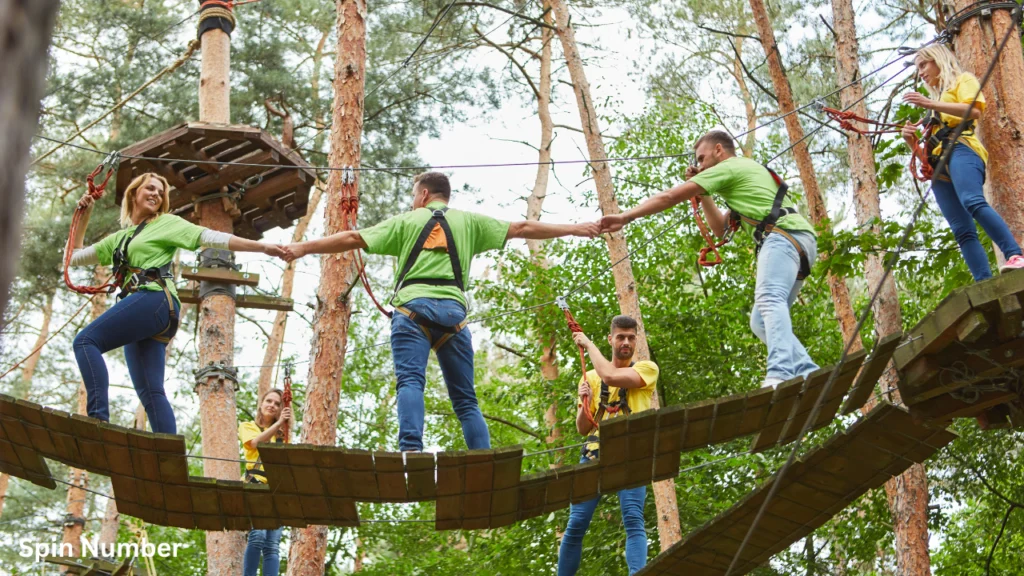
- Field problem course. A series of outdoor challenges that require the whole team to physically solve a task together.
Fun, Low-Stakes Social Activities
Not all team building activities need a lesson. Sometimes morale is the goal, and shared enjoyment is the point.
- Themed team lunch. A meal with one rule: no work talk. Simple, and reliably appreciated.
- Board game afternoon. Let people pick games and form tables. Low pressure, high connection.
- Hidden talents showcase. Everyone shares one surprising skill or hobby. People see each other as humans, not job titles.
- Group challenge day. A light bracket of quick games, with teams chosen at random using our spin the wheel games setup to keep it fair.
How to Run an Activity So It Sticks
This is the step most teams skip, and it is what separates team building activities that work from ones that do not. The research says it matters most. An activity without a debrief is just a game.
- Set the purpose out loud. Tell the team what the activity is for (“this is about how we communicate under pressure”). Naming the goal turns play into learning.
- Keep it genuinely optional and safe. Forced participation breeds resentment and the opposite of psychological safety. Let people opt out without penalty.
- Debrief immediately. Afterward, ask three questions: What happened? What does that tell us about how we work? What will we do differently? This is where the value is created.
- Connect it to real work. Link a lesson from the game to an actual team challenge, or it stays a fun memory with no transfer.
- Keep it short and well-paced. Energy fades. End an activity while people still want more.
Common Mistakes to Avoid
Even well-chosen team building activities fail when they are run carelessly.
- Mandatory fun. Announcing an activity as compulsory undermines the trust you are trying to build. Invite, do not order.
- No debrief. Running the game and moving on wastes most of its value. The conversation afterward is non-negotiable.
- Ignoring introverts. High-energy, performative games exhaust quieter members. Mix in low-key options and small-group formats.
- Mismatched activity. A trust fall for a team that needs goal clarity solves nothing. Match the exercise to the actual need.
- Treating it as a fix. Team building cannot repair burnout, bad management, or unfair pay. Address those first.
How to Tell If It Worked
You do not need a survey to know whether your team building activities landed. In the weeks after a good activity, look for small behavioral shifts: quieter people speaking up more, smoother handoffs, faster conflict resolution, more cross-team asks. If you want a measure, a short pulse check on trust and communication before and a month after gives a rough read. The honest test is whether anything changed on a normal workday, not whether people enjoyed the afternoon.
Frequently Asked Questions
What are good team building activities for work? Match them to a goal. For a new team, use icebreakers; for friction, use communication exercises; for an established team, use problem-solving games like the marshmallow challenge. Always finish with a short debrief.
Do team building activities really improve performance? Research finds a positive, moderate effect, strongest on how teams feel and work together, especially when the activity targets goals, roles, or problem-solving and is reinforced with follow-up. They help most as a complement to good day-to-day conditions.
What are the best virtual team building activities? Ones designed for a screen: virtual coffee pairings, online trivia, show and tell, and virtual escape rooms. They rebuild the informal connection that remote teams lose.
How long should a team building activity take? Anywhere from five minutes for a meeting opener to a full day for an offsite. Whatever the length, leave time for a debrief, which is where the lasting value comes from.
How often should we do team building? Small, frequent touches (a quick check-in or game) beat one big annual event. Weave light team building activities into regular meetings and reserve larger offsites for a few times a year.
What if my team hates team building? Usually they hate bad team building: forced, pointless, or performative. Keep it optional, tie it to a real goal, debrief it, and choose low-key formats for quieter teams. Done right, the resistance fades.
Conclusion
Team building activities are not magic, and they are not a waste of time either. The evidence is clear: they produce real, moderate gains in trust, communication, and collaboration, but only when the activity fits the team’s stage and goal and is followed by an honest debrief that connects it back to work.
Start by naming what your team actually needs, pick one activity from the matching category above, keep it optional, and spend as much energy on the conversation afterward as on the game itself. Do that consistently, and team building stops being the thing people dread and becomes one of the quiet reasons your team works well together. Bookmark this page, and you will always have the right activity for whatever your team needs next.
References
Klein, C., DiazGranados, D., Salas, E., Le, H., Burke, C. S., Lyons, R., & Goodwin, G. F. (2009). Does team building work? Small Group Research, 40(2), 181-222. https://doi.org/10.1177/1046496408328821
Edmondson, A. (1999). Psychological safety and learning behavior in work teams. Administrative Science Quarterly, 44(2), 350-383. https://doi.org/10.2307/2666999
Tuckman, B. W. (1965). Developmental sequence in small groups. Psychological Bulletin, 63(6), 384-399. https://doi.org/10.1037/h0022100